
DfAM: Reinventing Performance - from Concept to HVAC
At FusiA Groupe, we don’t just print your files; we optimize your vision. Design for Additive Manufacturing (DfAM) is at the heart of our expertise, allowing us to push the boundaries of traditional design to create lighter, stronger, and more efficient solutions.
What is DfAM?
Unlike conventional methods (machining, casting) that impose shape restrictions, DfAM allows for the design of a part perfectly suited to its function. We leverage the geometric freedom of 3D printing for:
Topological Optimization: Placing material only where mechanical stresses require it.
Functional Consolidation: Reducing an assembly of 10 parts into a single, monolithic component.
Case Study: Optimizing HVAC Systems
One of our standout successes is the application of DfAM to HVAC (Heating, Ventilation, and Air Conditioning) components. In this sector, fluid management and thermal efficiency are paramount.

By using our approach, we transformed complex HVAC systems by:
Optimizing Airflow: Creating smooth-walled conduits with organic curves impossible to machine, significantly reducing pressure drops.
Reducing Weight and Footprint: Ideal for onboard installations (aerospace, transport) where every cubic centimeter and gram counts.
Conventional Design: The first image shows a part manufactured using traditional methods (machining or casting). The result is a heavy component that increases fuel and energy consumption during operation.
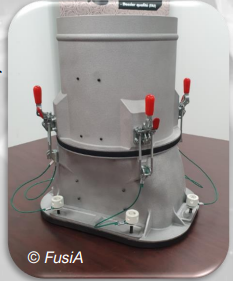
Optimized Design (DfAM): In the second image, the part has been entirely redesigned for 3D printing. By applying topological optimization, we removed all superfluous material to keep only the structural "backbone" of the part.
The Result: The weight was divided by 3. This massive reduction in mass was achieved while maintaining full structural integrity.
Concrete Benefits for Your Projects
Adopting DfAM with FusiA means choosing increased profitability from the design phase onward:
Reduced Assembly Costs: Fewer parts mean fewer screws, seals, and assembly time.
Improved Reliability: By eliminating welding or fastening points, we remove the risk of leaks or structural failures.
Accelerated Innovation: We move from digital simulation to the final part with absolute fidelity.
Article written by FusiA Groupe.


